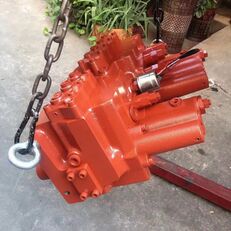
YA00000721 hydraulic control valve for Hitachi ZX280LC-5G ZX280-5G midi excavator


If you decide to buy equipment at a low price, make sure that you communicate with the real seller. Find out as much information about the owner of the equipment as possible. One way of cheating is to represent yourself as a real company. In case of suspicion, inform us about this for additional control, through the feedback form.
Before you decide to make a purchase, carefully review several sales offers to understand the average cost of your chosen equipment. If the price of the offer you like is much lower than similar offers, think about it. A significant price difference may indicate hidden defects or an attempt by the seller to commit fraudulent acts.
Do not buy products which price is too different from the average price for similar equipment.
Do not give consent to dubious pledges and prepaid goods. In case of doubt, do not be afraid to clarify details, ask for additional photographs and documents for equipment, check the authenticity of documents, ask questions.
The most common type of fraud. Unfair sellers may request a certain amount of advance payment to “book” your right to purchase equipment. Thus, fraudsters can collect a large amount and disappear, no longer get in touch.
- Transfer of prepayment to the card
- Do not make an advance payment without paperwork confirming the process of transferring money, if during the communication the seller is in doubt.
- Transfer to the “Trustee” account
- Such a request should be alarming, most likely you are communicating with a fraudster.
- Transfer to a company account with a similar name
- Be careful, fraudsters may disguise themselves as well-known companies, making minor changes to the name. Do not transfer funds if the company name is in doubt.
- Substitution of own details in the invoice of a real company
- Before making a transfer, make sure that the specified details are correct, and whether they relate to the specified company.
Seller's contacts

 +86 189 289...
+86 189 2896 5241

 China


 China


 China


 China


 China


 China
Product Overview
Quarry face loading is the hardest duty a 28‑ton excavator faces: constant heavy cycles, bucket teeth through rock, boom and arm working at the top of their load range for hours without pause. The ZX280‑5G and ZX280LC‑5G are built for that duty, and the hydraulic main valve, reference YA00000721, is what converts continuous pump flow into smooth, repeatable loading passes. Under that kind of rhythm, the block is worked harder than on any site machine, and its condition shows up directly in cycle time.
Wear on a quarry machine does not appear as a breakdown. It appears as a slightly softer bucket at the face, a boom that needs a nudge to hold a full load over the body, swing that drifts off the target line, and travel that bogs on the ramp out of the pit. Each one is internal leakage across worn spools, and on a quarry cycle repeated thousands of times a shift, they add up to measurable lost tonnage. This OEM‑grade main valve replaces the assembly complete with fresh internals trimmed to Hitachi values, so the worn unit comes off and the replacement goes into the stock port positions.
Core Advantages
1. Built to survive continuous loading duty
Quarry cycles repeat without rest. Fresh spool clearances hold pressure through that rhythm instead of degrading under it, so the block stays stable across a full shift.
2. Bucket bite returns at the face
When pressure leaks internally, the bucket loses urgency in rock. Renewed metering puts force back where the teeth meet the face.
3. Full loads stay over the body
A boom that sags on a loaded bucket forces corrections at the worst moment of the cycle. Restored retention keeps the load where the operator placed it.
4. Swing stays on the target line
At the pace of quarry loading, small swing errors repeat into lost seconds. Restored isolation ends the overshoot‑and‑correct habit.
5. OEM‑grade build at a cost that suits a working machine
Original assemblies carry pricing that competes with a machine's annual maintenance budget. Equivalent clearances and tested settings at a fraction, with tiered pricing for fleets running several Hitachi units.
Manufacturing & Quality Control
Spool and bore pairs are machined to print, matched by size, and hand‑run‑in until full‑stroke movement is free of binding. Assembled blocks are flow‑tested circuit by circuit, with relief and compensator values logged against ‑5G figures; out‑of‑window units are stripped and corrected. Blocks ship internally oil‑fogged, ports capped, and crated on foam.
Frequently Asked Questions
Q1: Does this block fit both the standard and LC builds?
A: The two designations share the platform, but port fittings can differ by build. Send the serial number and a photo of the existing valve tag and we confirm before shipping.
Q2: What symptoms appear first on a quarry machine?
A: A softer bucket at the face and a boom that needs correction to hold a full load. Both cost cycle time before anything actually fails.
Q3: Can the existing block be re‑spooled?
A: If the casting is sound and it has never been rebuilt, a kit can work. Under continuous quarry duty, a complete assembly usually gives longer service per dollar. Photos help us advise.
Q4: What hydraulic servicing accompanies the swap?
A: Flush the system, renew the return filter, clean the suction strainer, and refill with specified oil. Quarry dust and worn debris make this step essential.
Q5: How much downtime should be scheduled?
A: Most of a working day for removal and refit with the cover open, plus bleeding and pressure verification. Plan it into a maintenance window rather than a production day.
Q6: What is excluded from warranty?
A: Material and assembly faults are covered. Damage from dirty oil, water ingress, a spool forced against a bind, or reliefs altered outside specification is not. Photograph the crate before opening if damage is visible.